
Frontier or backwater?
Notes on advancing AI in Africa

I’ve been meeting a lot of people of late who ask me the same question: When will Africa catch up to the AI revolution? I usually tell them they’re asking the wrong question. Here’s the right one: When will the world catch up to what Africa is doing with AI?
Those were the opening remarks of Hardy Pemhiwa, CEO of Cassava Technologies, at a TEDx talk he delivered late last year in Vienna titled “AI’s Next Frontier Isn’t Where You Might Expect.” As presentations go, it was a well-paced performance delivered in the calm mien of an expert salesman painting a Pollyannaish vision of Africa, one in which the continent was writing an entirely different playbook for AI adoption. Or so it seemed.

Hardy reeled out the familiar statistics, beginning with Africa’s demographics. He correctly noted that the continent has a youthful median population that is tech-savvy and primed to engage deeply with technology, although the underlying reasons are not especially palatable. There is, after all, a reason countries like Kenya and Nigeria rank among those that spend the most time on social media globally.
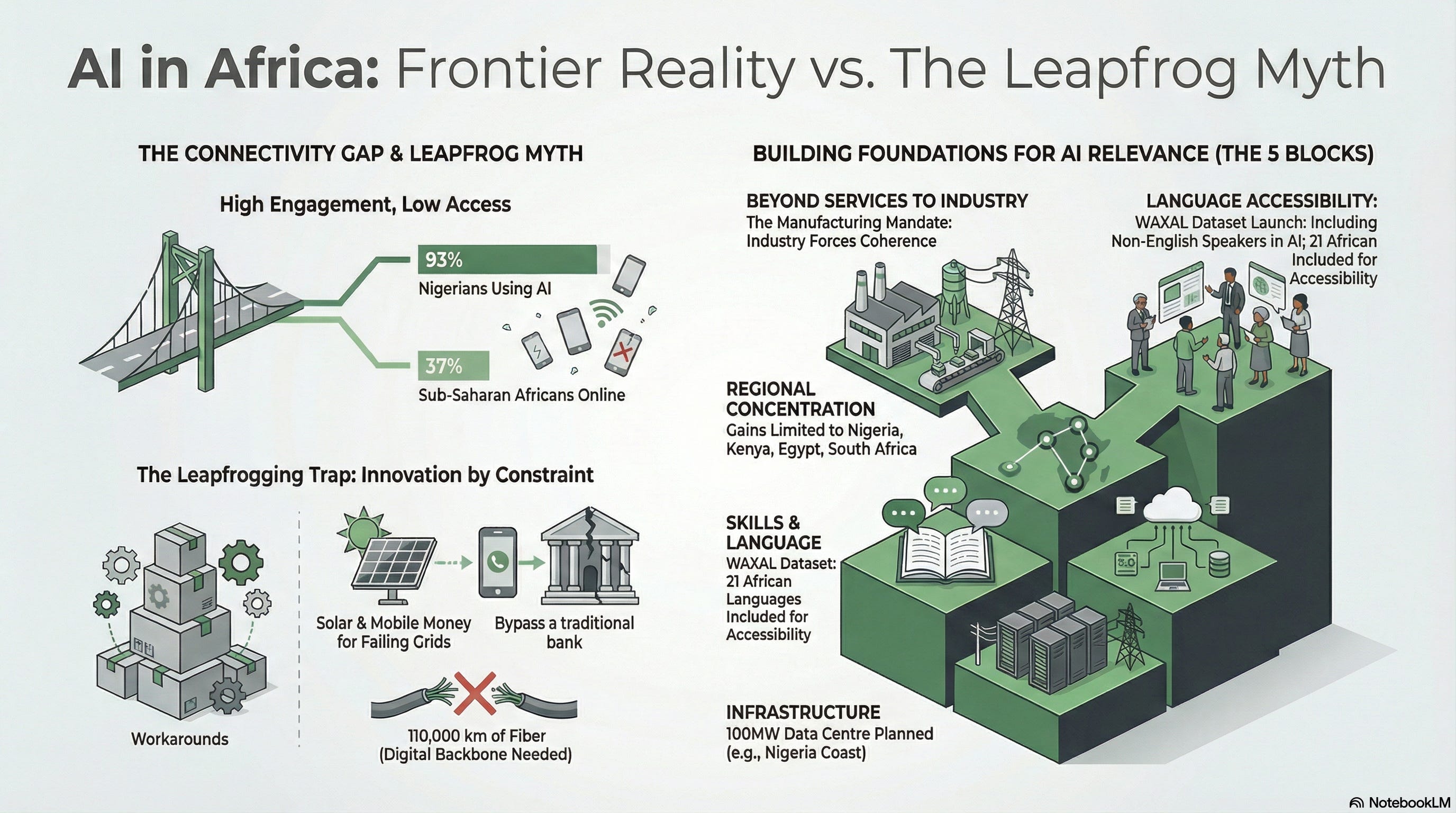
There is supporting evidence for his view. Google’s recently released Our Life with AI 2025 report notes that Nigeria leads the world in reported AI usage. Ninety-three per cent of Nigerians say they use AI to learn or understand complex topics, 19 percentage points higher than the global average.
Other claims, however, were less precise. Hardy’s assertion that by 2050, 60% of the world’s youth will be African overstates the case. While Africa’s youth bulge is significant, projections suggest the continent will represent about 25% of the world’s total population by that date, with closer to 40% of the world’s children. Still, he described Africa’s youth as “digital natives,” building on a narrative of rapid technological adoption. Where “75% of Africans had never heard a phone ring 30 years ago,” he said, “the continent now boasts over one billion mobile connections and 1.1 billion mobile money accounts.”
Hardy’s central thesis was that Africa’s core challenge is not poverty or disease per se, but youth unemployment. To illustrate this, he told the futuristic story of Yemurai, a 24-year-old high school graduate from Zimbabwe who, through AI academies launched by Cassava Technologies, has become what he calls an “AI-amplified community entrepreneur. “In the mornings, she uses AI tools to teach mathematics to 200 students across five schools. By noon, she assists nurses in diagnosing malaria and tuberculosis at local clinics. In the evenings, she analyses soil samples and diseased crops for neighbours, increasing yields by as much as 40%.”
This model, Hardy explained, addresses chronic shortages of teachers, doctors, and agronomists in rural Africa while simultaneously increasing individual income up to three times that of peers.
As he ended, he was greeted with rapt applause. However, I was neither impressed nor convinced.
The innovation myth
To be clear, there is much to commend in Cassava Technologies’ actual work. The company, owned by Strive Masiyiwa, has announced strategic partnerships with Google and Nvidia, valued at hundreds of millions of dollars, to supply GPUs for AI data centres across the continent. Its leadership previously ran Econet Wireless, which, in its early days, helped drive the widespread adoption of telecommunications across Africa. Cassava has also rolled out over 110,000 kilometres of fibre-optic cable, a critical backbone for real-time AI inference that requires high data-transfer speeds and low latency, which only fibre can reliably provide.
My difficulty lies less with the company’s execution than with the framing and its implications. The suggestion that the rest of the world ought to “catch up to what Africa is doing with AI” borders on the risible. Innovation on the continent, as Hardy himself explicitly acknowledges, is largely driven by constraint. While this appears to play to the maxim that necessity is the mother of invention, the litmus test for whether something is truly innovative is in how replicable it is elsewhere. Anecdotal evidence suggests that we typically copy and adopt from outside rather than build exportable models that others can emulate. Consider fintech: while Africa has produced innovative payment solutions for local markets, the continent’s most successful tech companies (PayStack, Andela, Flutterwave) still largely replicate models proven in Western markets, adapted for local contexts. This is not to say that copying is inherently bad, but rather our “inventiveness” is often a survival strategy, not one designed for scale.
Consider also his mobile money analogy. The success of platforms like M-Pesa in East Africa hinges on structural and cultural deficits. Structurally, large segments of the population remain excluded from formal banking, despite sustained efforts to “bank the unbanked,” particularly in rural areas where ATM access is limited. Even among those with bank accounts, mobile money is often preferred for its speed and convenience. Culturally, there remains deep distrust of banking institutions, fuelled by opaque charges, taxes, and a long-standing preference for keeping one’s cash close. To its credit, the mobile money model solves real problems for Africans. While it has influenced similar systems in parts of Asia and Latin America facing comparable infrastructure gaps, its success remains largely confined to situations where formal banking infrastructure is weak. It is a solution to scarcity, not a model for optimised financial systems. You cannot export it to environments where banking infrastructure already works efficiently.
This adaptation to infrastructural scarcity is frequently celebrated as “leapfrogging.” But it also points to a broader dysfunction. One that has not only been normalised, but institutionalised. Bypass the underlying problem, take a shortcut to the outcome, and congratulate yourself for ingenuity. Much of this is government failure, and it is not an indictment of private actors who, whether driven by passion or profit, attempt to work around these constraints. The broader concern is that we risk reframing what is plainly the fruits of incapacity (from the outside looking in) as a virtue, or worse, as a model others should emulate. To state the obvious from the Yemurai scenario, having someone work three jobs a day to earn a linear increase of three times the average wage is exploitation, and one should only applaud it if the parties involved in this arrangement seek burnout and a shortened lifespan as a reward.
While Hardy celebrates over one billion mobile connections, only about 37% of Sub-Saharan Africans are actually online. In countries such as Burundi, internet penetration hovers around 12.5%. Mobile money and POS terminals are praised as a success in place of building robust, inclusive banking systems that provide small business owners access to credit facilities. Solar panels proliferate as a cheaper workaround for failing power grids. Boreholes spring up indiscriminately as substitutes for moribund water boards unable to supply potable water to urban populations.
Feyi Fawehinmi captures this reality starkly:
“If, as a developing country, you failed to develop the critical skill of last-mile connectivity that allows your country to become legible, you can kick the can down the road, but the problem never goes away.
If you didn’t do it with the post office, emails didn’t ‘leapfrog’ the problem. You still needed to do it with landlines. If you didn’t do it with that, mobile phones didn’t ‘leapfrog’ the problem. You still needed to do it with broadband.
You still need to do it with power and grid connectivity. Rooftop solar panels won’t ‘leapfrog’ the problem. It will show up elsewhere. Every solar panel installed on a rooftop, because it’s cheap from China, is simply accepting that you’re just not going to make it.”
When will Africa catch up to the AI revolution?
Let us answer the original question, this time without reframing to suit a narrative. In my work as a data journalist, I have identified five building blocks Africa needs in place to be relevant on the global stage. In summary, they are: Electricity, data centres, the internet, digital and AI skills, and language.
Recently, some progress has been made. Just this month, Google unveiled WAXAL, an open dataset for 21 African languages, built in collaboration with African academics. The hope is that, over time, more languages will be included in its corpus, increasing accessibility for non-English-speaking populations who are largely excluded from the benefits of using AI.
AI data centres are also springing up, in line with one of my predictions for the year. As reported by TechCabal, a 100MW data centre along the Lagos-Calabar coastal road, facing the Atlantic Ocean, could go live in Nigeria this year.
However, excited as I am about these developments, I must state some painful caveats. First, whatever gains AI makes on the continent are concentrated around the big four: South Africa, Kenya, Nigeria and Egypt. While several African countries have some form of documentation for implementing AI strategies, bringing them to life requires hefty capital investment that is simply out of reach for most governments with more pressing priorities.
Second, Africa needs an industrial revolution, propelled by manufacturing. In a read I highly recommend, Jostein Hauge cogently argues, with historical data, that the popular notion that developing countries can bypass manufacturing and leapfrog straight to services is an exercise in wishful thinking. One of the benefits a revamped manufacturing base confers is that it forces binding constraints and coherence along several interconnected links, including energy, road networks, supply chains, quality control, policy, and so on. Each one works in lockstep over a long time horizon, leading to positive spillover effects across other sectors that ultimately encourage the faster diffusion of technology.
Kenya has the perfect confluence of conditions needed to be a manufacturing giant. It boasts abundant geothermal energy, a strategic location as a gateway to the East and Central African trade corridor, a robust regulatory framework, world-standard warehousing facilities in its Special Economic Zones (SEZs) that offer reduced corporate taxes for manufacturers, and relatively better road infrastructure for the movement of raw materials. Yet, it is learning firsthand just how difficult it is to make that transition. As part of a “friend-shoring” strategy under the Biden-led administration, the US spread chip production to Kenya, where STL, a semiconductor manufacturing plant, became a beneficiary. The company received a $1.3m grant from the US, which, welcome as it was, was a pittance compared to the $350 million it needed to raise to produce 30,000 wafers. A change in administration brought the inflow of the American greenback to a halt. Vietnam, a US ally in similar circumstances, invested $500m to spur its first manufacturing plant; Kenya, meanwhile, remains stuck in limbo.
So, will Africa catch up? Not yet. South Korea and Vietnam prove the transformation is possible, as I have argued, but both started with something Africa keeps avoiding: confronting infrastructure deficits head-on rather than attempting to leapfrog them. That is the honest assessment required. Governments must abandon the fantasy that solar panels and mobile money can substitute for functional power grids and banking systems. How soon Africa heeds this reality will determine whether the continent becomes a genuine frontier economy or remains stuck romanticising workarounds.